

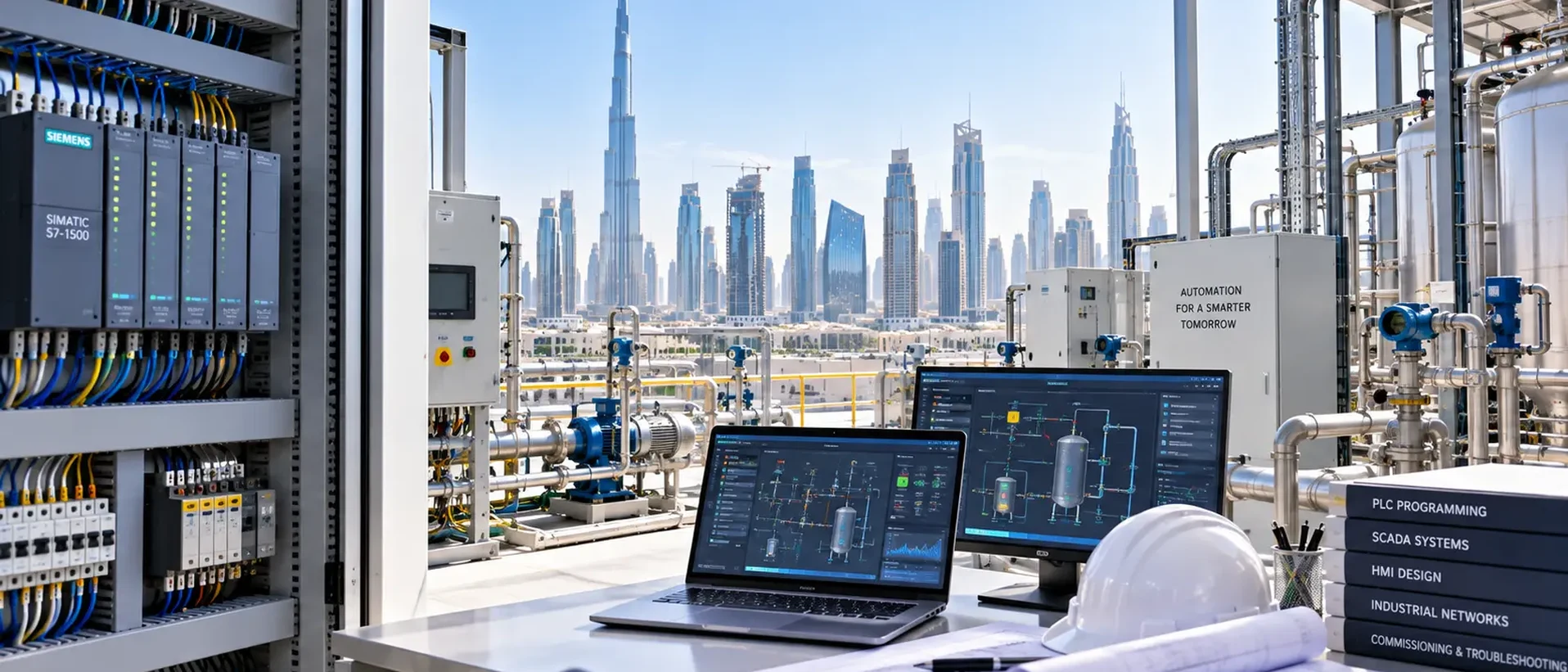
PLC vs SCADA: What Dubai Facility Managers Need to Know
PLC and SCADA get used interchangeably, but they do different jobs. A plain-English guide for facility and plant managers.
Quick answer
A PLC (programmable logic controller) is the hardware that directly controls equipment — starting a pump, opening a valve, running a sequence. SCADA (supervisory control and data acquisition) is the software layer that lets you see and control multiple PLCs from one screen. In short: PLCs do the work, SCADA lets you watch and manage it.
For help with either layer, see PLC programming and SCADA and HMI systems. In commercial buildings the supervisory role is often played by the BMS.
What a PLC actually does
A PLC is a small industrial computer wired directly to sensors and equipment on site — a pump, a damper, a chiller, a production line. It runs the logic that decides what happens next: if this sensor reads above a threshold, start that pump; if this door opens, stop that conveyor. It works whether or not anyone is watching a screen, which is why PLCs are the layer you can't skip, even in a small plant room.
What SCADA adds on top
SCADA doesn't replace PLCs, it sits above them. It pulls data from every PLC on a site (or across multiple sites) into dashboards, trends and alarms, so a facility manager can see the whole picture from one screen instead of walking to each plant room. It also lets you adjust setpoints, acknowledge alarms and review historical data without physically accessing each panel.
For a single small plant room, SCADA can be overkill — the PLC alone might be enough. For a building or facility with multiple systems (chillers, generators, fire pumps, BMS points) spread across floors or sites, SCADA is usually what turns "we have automation" into "we can actually manage it."
How to decide what you need
Start with what problem you're solving. If equipment keeps failing without warning, SCADA's alarming and trending will show you patterns a PLC alone won't. If you're commissioning a new system from scratch, you need PLCs regardless, and can add SCADA now or later depending on budget and site complexity. If you already have PLCs installed but no visibility, adding SCADA is often the highest-value next step, since the hard part (the control logic) is already done.
Talk to an engineer about your project.
Frequently asked questions
Do I need SCADA if I already have a Building Management System (BMS)?
Often a BMS covers HVAC, lighting and similar building-wide systems, while SCADA is used for more industrial or plant-specific processes. Depending on the facility, they can overlap or be integrated — worth having an automation engineer review what you already have before adding a new layer.
How much does it cost to add SCADA to an existing PLC system?
It depends on how many PLCs need to be connected and whether they use a common communication protocol. A site survey is the only reliable way to scope it, since retrofitting older or mismatched PLCs is usually the biggest cost driver.
What happens if a PLC fails but SCADA is still running?
SCADA will typically show a communication alarm or loss of data from that PLC, but it can’t control the equipment itself — that logic lives on the PLC. This is why PLC reliability and a documented troubleshooting process matter more than the SCADA layer on top.
What is an HMI and how is it different from SCADA?
An HMI is an operator screen, usually on a machine or panel, connected to one or a few PLCs. SCADA is a supervisory system across a whole plant or several sites, with data logging, trends, reports and alarm history. Many plants use both.
Can SCADA control equipment if the PLC is offline?
No. SCADA sends commands through the PLC, so if the PLC stops, SCADA can only show the last known values and alarms. That is why PLCs are designed to keep the process safe on their own.
Related services
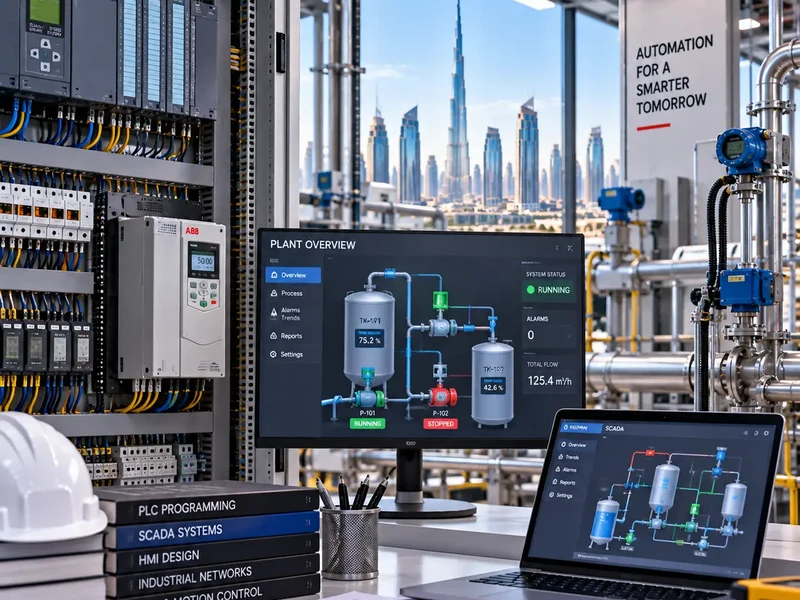
Industrial Automation
PLC and SCADA design, installation, commissioning and troubleshooting.
Read moreSCADA & HMI Systems
Screens your operators can read at a glance, alarms that mean something and data you can actually use.
Read morePLC Programming
Control logic that's clear enough for your maintenance team to read, and tested before it ever reaches site.
Read moreMore from the blog

Noise Complaints in Dubai Buildings: How Acoustic Engineering Fixes Them
A practical look at how acoustic engineering actually resolves noise complaints in Dubai buildings, from tracing the source to fixing it properly.
Read article
CCTV Installation in Dubai: A Practical Guide for Businesses
What businesses in Dubai actually need to think about before installing CCTV, beyond just picking a camera.
Read article
How Much Does an MEP Contractor Cost in Dubai?
What MEP contracting actually costs in Dubai, what drives the price up or down, and the questions to ask before you sign a quote.
Read article
Ready to talk about your project?
Call +971 524064300, or send us your drawings and we will reply with next steps.